NASA often appears in the news for rockets and astronauts. However, NASA also studies Earth. Recently, the agency shared new satellite technology that can scan the planet using laser systems. This may sound like space science, yet it connects to something surveyors use every day: lidar mapping.
Technology made for space often helps tools on Earth improve. In fact, many tools used in surveying today started in research programs. Later, they became common in everyday work. Because of that, surveyors pay attention when NASA creates new ways to measure the planet’s surface.
This new satellite system collects detailed elevation data across large areas of Earth. Satellites work far above the ground. However, the same basic idea powers lidar mapping used by surveyors in places like San Diego. As research continues to advance this mapping technology, the tools surveyors use on the ground continue to improve as well.
What Lidar Mapping Does for Land Surveying
To see why this matters, it helps to understand what lidar mapping does.
Lidar stands for Light Detection and Ranging. The system sends laser light toward the ground. Then it measures how long the light takes to return. Because the system knows how fast light travels, it can calculate the distance between the sensor and the land.
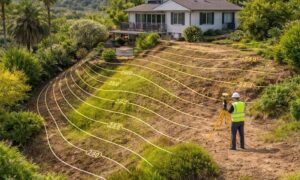
Each laser pulse becomes a measurement point. When millions of these points come together, they form a detailed 3D picture of the land. Surveyors call this a point cloud. From that data, they create terrain models that show slopes, elevation changes, and the shape of the land.
Because lidar mapping collects so much data quickly, it has become very useful in surveying. Surveyors use it to map large areas that would take much longer with traditional tools. As a result, engineers and planners can see the land clearly before construction begins.
At the same time, lidar mapping helps surveyors build clear elevation models for design work. Roads, drainage systems, and building layouts all depend on accurate land data. As modern lidar mapping technology continues to improve, surveyors can capture more detailed elevation information and give engineers a clearer picture of the land before construction begins.
Why NASA Is Investing in Laser Mapping from Space
NASA’s new satellite technology uses the same idea of laser scanning. However, it works on a much larger scale. Instead of mapping one property or construction site, satellites scan huge parts of Earth.
These satellites send laser pulses toward the ground and record the signal when the light returns. By collecting many measurements, scientists can study how the planet changes over time. For example, they may track mountain height, forest growth, or ice thickness.
Although these missions focus on research, the technology keeps improving. NASA engineers build sensors that collect more data and work with better accuracy.
Because research programs push technology forward, industries like land surveying often benefit from these advances.
How Space Research Often Shapes Surveying Tools
New technology usually develops step by step.
First, scientists design systems to solve research problems. Next, agencies test the technology through experiments and missions. After engineers prove the system works, companies adapt it for everyday use.
GPS followed this same path. It first served military and research projects. Later, it became a common tool used by surveyors around the world.
Laser mapping technology follows a similar path. When researchers create better sensors for satellites, companies learn how to build smaller versions for aircraft and drones. Over time, surveyors gain access to tools that collect more accurate land data.
Because of this pattern, advances in space technology often show where lidar mapping may go next.
How Lidar Mapping Has Improved in Recent Years

Over the past ten years, lidar mapping has improved a lot. New sensors collect many more measurement points than older systems. Because each point shows a distance, more points create more detailed maps.
At the same time, computers process lidar data much faster than before. In the past, turning lidar data into useful terrain models took a long time. Today, modern software can turn point clouds into digital maps much more quickly.
These improvements help surveyors deliver results faster while still keeping strong accuracy. Engineers can begin planning sooner because they receive land data earlier.
Another improvement allows surveyors to map larger areas in a single scan. Aircraft with lidar sensors can capture wide regions of land efficiently. As a result, large projects like highways or development sites can be mapped faster.
Why Drone Lidar Mapping Is Growing
Aircraft still play an important role in mapping. However, drones have added new options for lidar mapping.
Drone systems allow surveyors to collect data from lower heights. Because drones fly closer to the ground, they often capture very detailed elevation information. This makes them helpful for smaller sites and complex land shapes.
In addition, drones can reach areas that are hard to measure on foot. Thick plants, steep land, or busy construction sites become easier to survey from the air.
Because drones work quickly, they reduce the time survey crews spend in the field. This helps projects move forward while still producing reliable land data.
As drone technology improves, lidar mapping will likely become even more common in surveying work.
Why Better Lidar Mapping Helps Property Owners and Developers
Even though lidar technology sounds technical, it brings clear benefits for property owners and developers.
Accurate elevation data helps engineers understand how land slopes across a site. With that knowledge, designers can plan roads, drainage systems, and buildings more carefully.
Faster mapping also supports project schedules. When surveyors gather site data quickly, engineers can start design work sooner. This helps projects move forward without delays.
Clear terrain models also help avoid surprises later. When the shape of the land becomes clear early in a project, design teams can make better decisions.
Because of these benefits, lidar mapping has become an important part of modern land surveying.
What the Future May Hold for Lidar Mapping
As technology continues to improve, lidar mapping will likely become even more powerful.
Satellite research programs keep testing new laser sensors and mapping systems. Over time, these innovations may influence the tools surveyors use on aircraft and drones.
Future lidar systems may capture even more data points and process information faster. Surveyors may also combine data from satellites, aircraft, and drones more easily.
Because accurate land information supports many industries, improvements in mapping technology will continue to matter.
The Connection Between Space Technology and the Future of Surveying
NASA’s investment in Earth observation technology shows how important laser-based mapping has become. While these missions focus on studying the planet, the technology behind them often guides the next generation of surveying tools.
As new systems move from research labs into commercial equipment, surveyors gain stronger ways to measure land.
For property owners, engineers, and developers, this progress brings clearer land data and better planning. In the end, the goal stays simple: understand the land before building on it.
And thanks to the continued growth of lidar mapping, that understanding keeps improving.