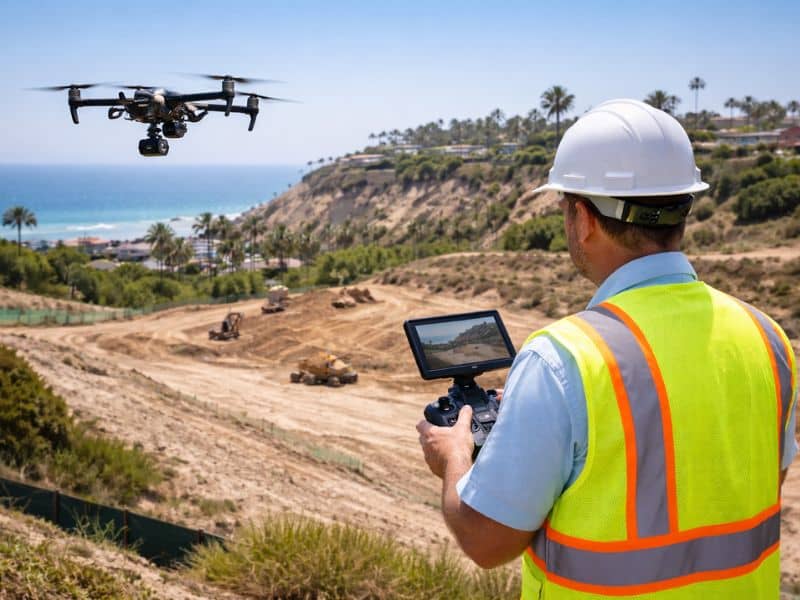
Land mapping drones are changing how survey teams capture site data. They can cover large areas faster, produce detailed visuals, and help teams make earlier decisions during planning. In San Diego, that speed matters, but so does compliance. Commercial drone operators must follow FAA Part 107 rules, and flights in controlled airspace require prior authorization through LAANC before they fly.
Why Drone Mapping Is Getting More Attention in San Diego
The recent pressure around drone work is not really about whether the technology is useful. It is about where and how it can operate. San Diego has dense urban areas, military influence, busy airports, coastal development, and public land restrictions that can complicate flight planning. The FAA’s current guidance makes clear that authorization is required for drone flights under 400 feet in controlled airspace around airports, and the agency has also stepped up drone enforcement actions tied to unsafe or unauthorized operations.
That matters for survey firms because drone mapping jobs are often scheduled around tight design, permitting, or construction timelines. A project may look simple on paper, but if the site sits near controlled airspace or a restricted launch area, the field plan can change quickly. The FAA also warns that local “No Drone Zone” rules may prohibit takeoff and landing from certain properties even when federal airspace approval exists.
How Land Mapping Drones Help Survey Work Move Faster
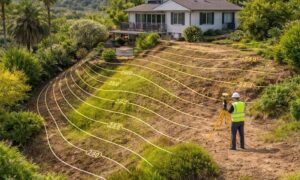
When conditions are right, drones can help capture a site more efficiently than traditional ground-only methods. They are useful for orthomosaic imagery, surface modeling, progress tracking, and early site review. That can give owners, engineers, and survey teams a faster look at terrain and site conditions before larger decisions are locked in.
This is one reason the technology keeps gaining traction. It can reduce repeated site visits, improve visual communication, and help teams spot issues sooner. In practical terms, land mapping drones are valuable because they support faster data collection without removing the need for professional oversight and control.
What Rules Can Delay a Drone Mapping Project
The biggest delays usually come from compliance, not hardware. For commercial work, the FAA says the operator must fly under Part 107 unless another approval applies, and the remote pilot must hold the required certificate. Flights in controlled airspace must be authorized before the mission, typically through LAANC.
There is also a second layer that many clients do not expect. Airspace approval does not automatically give permission to launch or land from a local property. The FAA explicitly says local restrictions can still apply through “No Drone Zone” rules. In San Diego County parks, for example, there is a formal unmanned aircraft permit application process, which shows how local land-use rules can affect otherwise workable drone plans.
Why Local Conditions Matter More in San Diego
San Diego is not just another city for drone operations. Local conditions make planning more sensitive. Sites may sit near airports, along the coast, near wildlife-sensitive areas, or on public land with separate rules.
That is why this goes beyond just using the right equipment. Taking a smarter approach to planning your site data helps teams account for airspace, access, and local restrictions before the project begins, instead of adjusting plans after delays occur.
How to Plan a Smoother Drone Mapping Job
The best approach is to treat drone mapping like part of the survey plan, not a last-minute add-on. Check the site’s airspace early. Confirm whether the launch point is allowed. Review local property or park restrictions. Make sure the operator is flying under the right FAA framework and that the timing works for the project.
A smooth project usually comes down to preparation:
- check airspace and authorization needs early
- confirm legal takeoff and landing access
- review local site restrictions before scheduling
- match the drone scope to the actual project goal
- build extra time into jobs near sensitive airspace
Land mapping drones can save time, but only when the flight plan is realistic. In San Diego, careful planning is what turns drone mapping from a cool tool into a reliable project asset.